
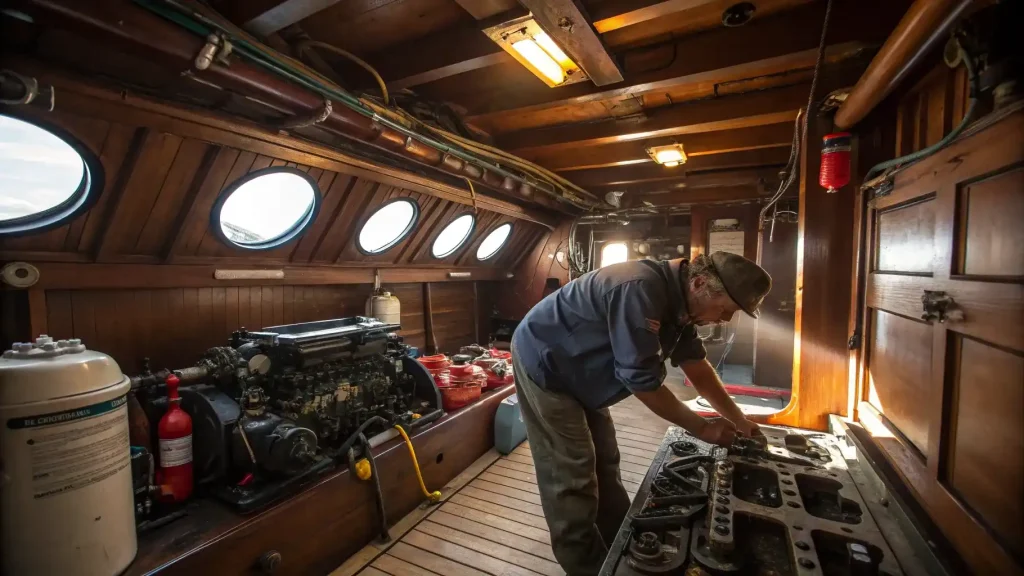
On a repower, the yard time is short and the procurement time is long. Ordering engines and controls at scope stage, months before the lift, is what makes a repower a three-week job instead of a lost season. The technical risks sit in the removal route, the engine beds and the final alignment.
Repowering is one of the few jobs where the Bali constraint is not skill or facilities. Mechanics here handle engine work constantly. The constraint is that every significant component is imported, and a boat sitting on blocks waiting for a coupling is paying hardstand fees for nothing.
Decide first: repower or rebuild
Before ordering anything, the question deserves a straight answer. A rebuild suits an engine that is mechanically sound in its major castings, has parts availability, and sits in a vessel where the installation is otherwise good. A repower suits an engine that is out of support, whose parts are scarce, or where the vessel’s duty has changed.
The trap is a half-answer: replacing the engine while retaining a tired gearbox, an undersized shaft, worn bearings and old controls. The new engine then exposes every weakness downstream of it, and the owner pays for a second job within a year.
Engine, mounts, gearbox, coupling, shaft, bearings, seal, propeller, controls, instrumentation, exhaust, cooling, fuel supply and electrical. If any of those is left in place on assumption rather than inspection, it becomes the next failure.
Procurement: the real critical path
| Item | Why it needs early ordering |
|---|---|
| Engines and gearboxes | Build slots and shipping; often the longest single lead time. |
| Flexible mounts | Must match the engine’s mass and torque; substitutions cause vibration problems. |
| Shaft and coupling | Frequently made to measure once the new engine position is fixed. |
| Propeller | Pitch and diameter must suit the new power and gear ratio; often a re-pitch or new wheel. |
| Controls and instrumentation | Electronic control systems are engine-specific and easy to under-order. |
| Exhaust components | Sizing changes with engine output; hose and waterlock capacity must follow. |
Order by part number, not description, and confirm the propeller calculation before the wheel is ordered rather than after the boat has been trialled at the wrong pitch.
Getting the old engine out
The removal route is surveyed before anything is disconnected. On many production boats the engine went in before the deck did, which leaves three possibilities: out through a hatch that must be enlarged temporarily, out through the saloon with joinery removed, or a deck section lifted. Each has a cost and a reinstatement scope, and finding out which applies on the day the crane is booked is an expensive way to learn.
Practical points that repeatedly matter:
- Photograph and label everything before disconnecting. Wiring looms in particular are far easier to reconnect from photographs than from memory.
- Drain and contain fluids properly. Yard environmental rules in Bali are taken seriously and a spill on a shared hardstand is everybody’s problem.
- Protect the interior. Grinding dust and engine oil ruin more upholstery on repowers than any other job.
- Check the crane or hoist reach against the boat’s position on the hardstand before the lift is scheduled — a point that overlaps with yard access considerations in Bali boat yard locations.
Engine beds and alignment
New engines rarely land on old beds without work. Bed height, width, spacing and fore-and-aft position all change with the engine and gearbox combination, and the shaft line is fixed by the stern tube. The bed is therefore modified to bring the engine to the shaft, not the other way round.
Where beds are modified, the structure matters: a bed is a load path into the hull, not just a mounting shelf. Extensions or new beds must tie into the existing structure properly, and on GRP that means laminating to a schedule rather than bonding a top plate and hoping.
Alignment sequence
- Rough alignment on the hardstand to set bed positions and mount heights.
- Final alignment afloat, after the boat has been in the water long enough to settle. A hull supported on blocks is not in the same shape as a hull supported by water, especially on GRP.
- Re-check alignment after initial running hours, once mounts have settled under load.
- Record the figures. Alignment measurements belong in the job file; they are the reference point for every future investigation of vibration.
Final alignment set on the hardstand and never re-checked afloat. It produces vibration, accelerated cutless bearing wear, and premature seal failure — and it is entirely avoidable.
Commissioning and trial
Commissioning follows the engine manufacturer’s schedule, not local habit: first run under supervision, checks for leaks and correct cooling flow, gearbox oil level after initial running, and a documented sea trial. On trial, the numbers that matter are wide-open-throttle rpm against the engine’s rated figure, temperatures under sustained load, and vibration across the range.
An engine that will not reach its rated rpm at wide-open throttle is over-propped and will be worked beyond its design load for the rest of its life. That is corrected by re-pitching the propeller, and it is far easier to address at trial than after a season of high exhaust temperatures.
Underwater running gear is normally addressed during the same lift — see propeller, shaft and rudder work during a haul-out. And because a repower is usually one item on a longer list, the sequencing logic sits with yacht refit Bali.
Aftercare
New engines need their early service intervals honoured strictly — first oil change, filter changes, valve checks where specified, and alignment re-check. Building those into a written calendar rather than a memory is the point of yacht maintenance Bali.