
Travel lift suits most GRP and light-displacement hulls; a slipway suits heavy displacement, long keels and timber; a mobile crane suits small craft and emergencies; careening and diver work suit inspection and touch-ups only. The choice is decided by weight, beam, draft on approach and hull form — not by preference or price.
“Can you haul my boat” is a question with four different technical answers in Bali, and picking the wrong one wastes a yard window. This is how each method works, what it loads, and where it fails.
Travel lift
A wheeled gantry straddles the vessel over a lift pit, passes slings beneath the hull, lifts, and carries the boat to a hardstand position. It is the default for most modern hulls because it is quick, it puts the boat where the work is, and it leaves the hull accessible on all sides.
Constraints:
- Beam through the gantry. A hard limit. This is what most commonly excludes catamarans.
- Weight. The lift’s rated capacity, with a real margin — not the boat’s brochure displacement but its loaded weight.
- Sling positions. Slings must clear shafts, struts, stabiliser fins, transducers and speed logs. Where the builder documented lifting points, they are used; otherwise a plan is drawn from the general arrangement.
- Depth at the lift pit at the tide state on the day.
A sling landing on a transducer or a stabiliser fin turns a routine lift into an insurance conversation. Marking sling positions on the hull, in advance and in paint that survives a pressure wash, is five minutes that prevents a five-figure problem.
Marine railway slipway
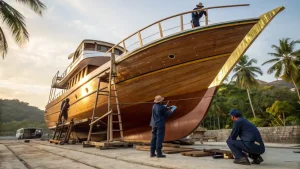
The vessel is floated onto a submerged cradle which is then winched up rails. The cradle carries the hull along its length rather than at two sling points, which is why it suits heavy displacement, long-keeled hulls and timber vessels that do not appreciate being suspended.
Constraints:
- Cradle fit. The cradle must be built or adjusted for the hull form; a poor fit is worse than a sling lift.
- Approach depth at the rails, which is tide-dependent at most Bali facilities.
- Occupancy. The slipway is shared infrastructure, so long stays are discouraged or charged accordingly.
- Access. Working around a hull on a cradle is more restricted than on open hardstand blocks.
The full comparison for lay-up purposes is in slipway versus hardstand.
Mobile crane
A road crane lifts the vessel from the water at a quay and places it on the hard. It is the flexible option: it works where there is no travel lift, it can be brought in at short notice, and it suits tenders, dive boats and small craft.
Constraints:
- Lifting points. The vessel needs documented, structurally adequate lifting eyes or a proven strop arrangement. Improvised lifting points are how boats get damaged.
- Reach and radius. Crane capacity falls off sharply with radius; a crane rated for the weight may not be rated for the weight at the distance required.
- Quay strength and access for a heavy road crane.
Tidal careening and grids
The vessel is settled against a wall or on a grid at high water and dries out as the tide falls, giving access to the underwater body for a few hours. It is inexpensive and genuinely useful for inspection, anode changes and small antifoul touch-ups.
Constraints: working time is set by the tide, not by the job; the hull must be able to take the ground safely; and no coating requiring extended cure can be applied. It is a maintenance tool, not a refit tool.
Diver work afloat
For hull scrubs, propeller cleaning, anode changes, inspection and video survey, a diver is faster and costs far less than any lift. What it cannot do is anything requiring a dry surface — which means all coating work, all laminate repair and all fastening work.
For a boat working hard in Bali’s warm water, scheduled diver scrubs between annual haul-outs are one of the best-value maintenance items available, because fouling costs fuel continuously. That fits into the calendar on yacht maintenance Bali.
Comparison at a glance
| Method | Suits | Cannot do | First thing to verify |
|---|---|---|---|
| Travel lift | Most GRP, aluminium, planing hulls | Excess beam or weight | Beam through gantry; loaded weight |
| Slipway | Heavy displacement, long keel, timber | Long stays; open access work | Cradle fit; approach depth |
| Mobile crane | Small craft, tenders, emergencies | Large or unlifted-point vessels | Lifting points; crane radius rating |
| Careening / grid | Inspection, anodes, touch-ups | Coating systems; structural work | Tide window; ability to take ground |
| Diver afloat | Scrub, props, anodes, survey | Anything needing a dry surface | Visibility and current |
How the method changes the scope
The lifting method is not a logistics detail; it shapes what can be done. A boat on a slipway cradle cannot easily have its blocking moved to coat the areas the cradle covers. A boat careened on a tide has hours, not days. A boat on hardstand blocks can have those blocks moved as a scheduled event so the entire underwater body is coated — which is why hardstand is the default for any serious coating programme.
Deciding the method belongs at scope stage, alongside draft, tide and slot planning. Those are covered in dry dock planning: tides, draft and booking windows and on the main Bali haul out and dry dock page.
Preparing the boat for whichever method is used
- Mark sling or cradle bearing positions on the hull in advance, in something that survives a pressure wash.
- Have the general arrangement available so blocking can be planned against structure rather than guessed.
- Agree tank state. Fuel and water change lift weight materially on a mid-size vessel and change draft on the approach.
- Retract or protect vulnerable fittings — transducers, speed logs, stabiliser fins — and tell the lift crew where they are.
- Clear the decks of anything that can move, and secure hatches.
- Brief the crew on where nobody stands: never under a hull while slings are taking or releasing load.
These six items take an hour between them and remove most of the risk that a lift carries. They are also the items that get skipped when a boat arrives on a tide with the lift already waiting, which is an argument for arriving early rather than exactly on time.