
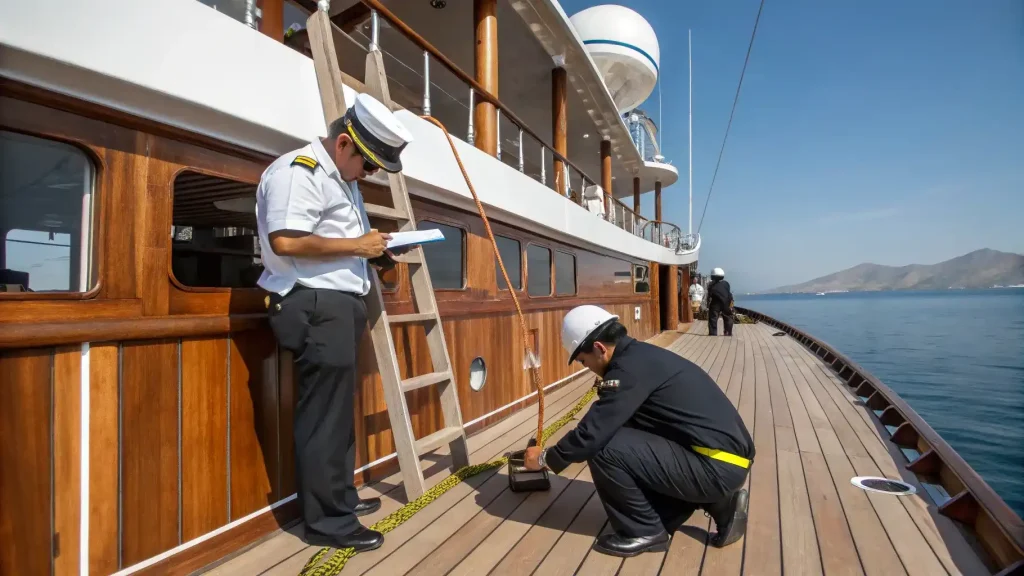
Boats on hardstands burn more often than boats afloat, and hot work is the usual cause. The controls that prevent it are unglamorous and inexpensive: a written hot-work permit, a dedicated fire watch during the work and for a period afterwards, and physical separation from anything combustible. Owners are entitled to insist on all three.
Yards ashore concentrate risk in a way that afloat berthing does not. Vessels sit close together, they are full of fuel and resin and cushions, there is grinding dust and solvent everywhere, and there is often no water main at the boat. A fire in that environment spreads between hulls.
Hot work: what counts and why it is dangerous
Hot work is anything that produces flame, sparks or enough heat to ignite: welding, cutting, grinding, brazing, soldering, and the use of heat guns and torches. The hazard is not only the obvious flame — it is that sparks travel, that heat conducts through metal into a void on the other side of a bulkhead, and that a smouldering ignition can develop for hours after the tools are packed away.
Minimum controls for hot work on a vessel ashore
- Written permit naming the location, the work, the person doing it, the person supervising, and the times.
- Area survey first. Identify what is on the other side of the surface being worked on, above it and below it — voids, tank spaces, wiring, insulation, fuel lines.
- Remove or protect combustibles within the spark radius, including on the far side of the surface. Fire blankets, not tarpaulins.
- Gas testing before any hot work near fuel tanks, bilges or enclosed spaces, and repeated after breaks.
- Extinguishers staged at the work, appropriate to the risk, plus water where the substrate permits.
- Dedicated fire watch — a person whose only job is watching, both during the work and for a defined period after it stops.
- Post-work inspection of the far side of the work and of adjacent spaces before leaving.
Most hot-work fires start after the welder has gone home, from a smouldering ignition in insulation or a void. A watch that ends when the tools stop is not a fire watch.
Coatings, solvents and dust
Coating work brings a different set of hazards, and they overlap badly with hot work happening on the boat next door.
- Solvent vapour is heavier than air and accumulates in bilges and low spaces. Ventilation must extract from low down, not merely blow across the top.
- No hot work near spraying. This is a scheduling problem as much as a safety rule — two boats side by side, one spraying and one grinding, is a foreseeable incident.
- Grinding dust from GRP and from antifoul is a genuine health hazard. Respiratory protection and containment are not optional, and antifoul residue is also a waste-handling obligation.
- Isocyanate-containing two-pack systems require air-fed respiratory protection, not a dust mask. If a yard’s spray crew is not equipped for it, that tells you something about the rest of their standards.
Confined spaces
Tanks, voids, chain lockers and sealed compartments kill people who go into them casually. The hazards are oxygen deficiency, accumulated vapour and, on older vessels, residues.
- Test the atmosphere before entry and continuously during it.
- Ventilate before and throughout.
- Never enter alone. An attendant stays outside with a means of raising help.
- Plan the rescue before the entry. Most confined-space deaths include a would-be rescuer.
Working at height and under a suspended hull
- Staging should be proper staging, not planks on drums. Hardstand ground in Bali is often uneven and softens after rain.
- Never work under a hull during lifting or blocking operations. Once blocked and stable, work beneath is normal; while slings are taking or releasing load, it is not.
- Stands and props are checked after the hull settles and after rain moves the ground. See Bali slipway and hardstand.
Electrical safety ashore
Shore supply on a hardstand is often improvised: long leads, multiple adaptors, connections lying on wet ground. Practical minimums are residual current protection at the supply, leads kept off the ground and out of water, and no daisy-chained adaptors. On a boat with work in progress, isolating the vessel’s own batteries and clearly labelling what is live prevents a great deal of trouble.
What owners should ask for
| Ask | What a good answer looks like |
|---|---|
| Is hot work permitted here and under what conditions? | A permit system exists and is described without hesitation. |
| Who provides fire watch, and for how long after work stops? | A named role and a defined post-work period. |
| Where are extinguishers and what is the alarm procedure? | Specific locations; a procedure that does not depend on one person. |
| How is coating waste and antifoul residue handled? | A compliant disposal route, costed in the quotation. |
| Can crew stay aboard during hot work? | Normally no, and a yard that says yes without conditions is worth a second look. |
| Is there insurance in place at the yard, and what does it cover? | A clear answer; your own cover ashore checked in parallel. |
Insurance and responsibility
Cover afloat does not automatically extend to a vessel ashore or under repair, and a yard’s own liability cover is not a substitute for the owner’s. Both need checking before the lift. Where the scope includes hot work, some policies impose specific conditions — and a fire following a breach of those conditions is precisely the claim that gets refused.
Safety expectations belong in the scope alongside the technical items, which is why they are agreed at booking rather than discussed on the day. The scoping process is on Bali boat repair.