
A workable Bali maintenance calendar is built around two fixed points: the annual haul-out, and the start of the dry-season charter run. Everything else schedules around those. The value is not in the list itself — it is in the discipline of writing down what was done and when.
This is a general framework for a mid-size motor or sailing vessel working out of Bali. It is written to be adapted, not copied. Manufacturer intervals always take precedence, and in tropical conditions they should be treated as ceilings rather than targets.
Weekly, while in service
- Bilges checked and dry; bilge pumps and float switches tested manually.
- Seacocks inspected visually; any weeping noted rather than remembered.
- Battery state and charging confirmed under load, not at rest.
- Fuel and water levels logged, with consumption compared against the norm — a change is a diagnostic signal.
- Hull and waterline checked visually for growth; mooring lines, chafe points and fenders inspected.
- Deck drains and scuppers cleared. In the wet season this is the single most valuable weekly task.
- Safety equipment present and accessible.
Monthly
- Engine and generator fluid levels, plus visual inspection for leaks while hot.
- Raw-water strainers opened and cleaned. In Bali these fill faster than owners expect.
- Belts and hoses inspected by hand for softness, cracking and glazing.
- Electrical connections in the engine space inspected for corrosion and heat discolouration.
- Anodes checked visually where accessible.
- Air conditioning and refrigeration performance checked under load.
- Watermaker run and flushed per its schedule, not only when needed.
- Tender and outboard run, flushed and checked.
Quarterly
- Diver scrub of hull, running gear and inlets; anodes measured by the diver, not estimated.
- Fuel polishing or filter change depending on condition and fuel quality.
- Steering system checked lock to lock, including emergency steering.
- Full safety-equipment audit: flares, lifejackets, EPIRB, liferaft service dates.
- Deck hardware and hatch seals inspected; anything weeping noted for the next yard period.
- Fresh-water system sanitised.
- Interior humidity and mould check, especially in lockers and under berths.
Annual — the haul-out period
This is the anchor of the whole calendar. Planned properly it covers everything that cannot be done afloat:
| Area | Work |
|---|---|
| Hull | Pressure wash, coating assessment, antifoul, moisture check, blister inspection. |
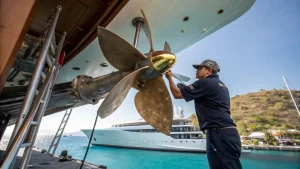
| Running gear | Cutless bearing clearance, shaft seal, propeller condition and pitch, rudder bearing. |
| Anodes | Full renewal plus bonding continuity testing. |
| Through-hulls | Seacocks serviced or renewed; hoses and double clamps checked. |
| Machinery | Major engine and generator service; heat exchangers cleaned. |
| Systems | Battery load test; electrical audit; gas system check where fitted. |
| Deck | Hardware re-bedding as required; hatch and window seals; caulk seams. |
| Rig (sailing) | Standing and running rigging inspection; terminals and fittings. |
Lift planning is on Bali haul out and dry dock; coating constraints in antifouling in Bali; running-gear detail in propeller, shaft and rudder work.
Multi-year items
- Coating renewal — barrier and topside systems on their own cycle.
- Shaft withdrawal for full-length inspection.
- Rudder bearing renewal.
- Battery bank replacement, planned rather than reactive.
- Fuel and water tank inspection and cleaning.
- Standing rigging replacement on sailing vessels, by age as well as by condition.
- Dripless shaft seal bellows — replaced on a calendar, not on hours.
- Full condition survey for insurance and value.
“Anodes checked” is worth little. “Shaft anode 40 per cent consumed at 11 months, bonding continuity 0.2 ohm” is a data point that becomes a trend, and a trend predicts failures. The log is the deliverable.
Fitting it to the Bali year
Before the dry-season charter run: everything that affects guest-carrying condition — air conditioning, refrigeration, tender and outboard, safety equipment in date, interior condition. See charter-readiness inspection.
Wet season: the natural window for yard work if you can accept weather days and use containment. Yards are less congested and the boat is out of the water when it is earning least — see wet season versus dry season.
Year-round: corrosion monitoring never pauses in warm water — see tropical corrosion control.
Who holds the calendar
A calendar without an owner is a document that gets ignored by March. On a crewed boat that is the captain or engineer. On an owner-operated boat kept in Bali while the owner is elsewhere, it needs somebody accountable locally, which is what the owner-reporting management service exists for. Where only yard periods are required, the desk described on yacht maintenance Bali is sufficient.
Turning the calendar into something that actually happens
Most maintenance plans fail for administrative reasons, not technical ones. Four practices make the difference:
- One owner for the calendar. A named person, not “the crew”. Shared responsibility is no responsibility.
- Fixed review dates, tied to the haul-out and to the pre-season inspection, where outstanding items are either scheduled or consciously deferred with a date.
- A spares list generated from the calendar, so consumables are on board before they are needed rather than ordered when something fails.
- Numbers, not ticks. Measurements make the log predictive; completion marks make it decorative.
Building the boat’s own spares baseline
| Category | Hold on board | Reorder trigger |
|---|---|---|
| Impellers | One per pump, minimum | On use |
| Filters (fuel, oil, air) | One full set per engine and generator | At each service |
| Belts | One per driven accessory | On use or visible wear |
| Anodes | One full set | At haul-out |
| Hose and clamps | Common sizes, plus double clamps | Quarterly check |
| Softwood plugs | One at every through-hull | Annual verification |
The point of a baseline list is that it makes the boat self-sufficient for the failures that are predictable, which are most of them.