
In Bali, fouling grows year-round and fast, so antifoul life is shorter than the tin suggests and preparation matters more than product choice. The two things that decide the outcome are substrate compatibility and whether the coating was applied inside its temperature, dew-point and overcoat windows.
Owners arriving from temperate waters routinely underestimate this. Warm, nutrient-rich water with constant daylight hours is close to ideal growing conditions. A coating that gives two comfortable seasons in Europe may be tired within one here, and a boat that sits at anchor rather than moving will foul faster still.
Why fouling costs more than it looks
- Fuel. Even light slime measurably increases drag; hard growth is worse again, on every leg of every trip.
- Cooling. Growth in inlets and strainers restricts flow and produces overheating alarms that get blamed on impellers.
- Running gear. Growth in a shaft log and on a propeller accelerates wear and unbalances the wheel.
- Corrosion. Biological activity under growth creates local conditions that attack metals; see tropical corrosion control.
Substrate preparation: where the job is won
Most antifoul failures are adhesion failures, and adhesion failures are preparation failures. The sequence:
- Wash immediately. Pressure wash while the growth is still soft, as the boat comes out. Dried growth is far harder to remove and can damage the coating during removal.
- Assess what is underneath. Sound existing antifoul that is compatible can be overcoated. Multiple tired layers, flaking, or an unknown history mean removal.
- Remove where necessary. Sanding, scraping or media blasting depending on the substrate and the build-up. Excessive accumulated layers add weight and eventually crack and shed regardless of what goes on top.
- Check compatibility. Not all antifouls can go over one another. A hard coating over a soft ablative, or an incompatible chemistry, delaminates.
- Repair the substrate. Blisters, damage and exposed laminate are addressed before coating — see osmosis and blister repair.
- Prime as specified. Bare substrate needs the primer the system specifies, not a general-purpose alternative.
“What is currently on the hull?” is the single most useful piece of information for an antifoul job, and it is the one most often unknown on a second-hand boat. Where the history is unknown, a test patch or full removal costs less than a hull that sheds its coating mid-season.
Coating types in a tropical context
| Type | How it works | Suits | Watch for |
|---|---|---|---|
| Soft ablative | Polishes away in use, exposing fresh biocide. | Boats that move regularly. | Poor performance on boats that sit still. |
| Hard matrix | Biocide leaches from a fixed film. | High-speed craft; hulls that get scrubbed. | Layer build-up over time; cracking. |
| Hybrid / self-polishing copolymer | Controlled polishing rate. | Mixed-use working boats. | Application thickness discipline. |
| Foul-release (silicone) | Low-adhesion surface rather than biocide. | Vessels with regular use and gentle cleaning. | Preparation is unforgiving; damage repair is specialist. |
Aluminium hulls and outdrives need copper-free systems, and getting this wrong causes rapid galvanic damage. This is not a preference, it is a compatibility rule.
Application windows in the tropics
Every coating data sheet states a temperature range, a maximum humidity, a minimum margin above dew point, and minimum and maximum overcoat intervals. In Bali all four are live constraints:
- Surface temperature on a dark hull in direct sun can exceed the coating’s stated maximum well before midday. Applying above it causes solvent flash-off, poor flow and pinholing.
- Dew point margin is the reason late-afternoon and evening application often fails: the surface cools towards dew point and moisture forms in the film.
- Humidity affects both cure and adhesion, particularly for primers.
- Overcoat windows are two-sided. Too soon traps solvent; too late means abrading the surface to key it before the next coat.
The practical result is that in Bali the reliable application window is often early morning, under shade or containment. That is why a two-coat job takes days rather than hours, and why weather days must be in the programme rather than absorbed as an overrun.
Waterline, running gear and details
- Waterline placement. A boat that floats deeper than designed — as most working boats do — needs the boot top raised, or it grows a green beard within weeks.
- Leading edges and high-wear areas benefit from an extra coat; they are where coating wears through first.
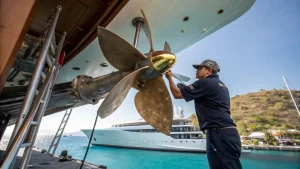
- Running gear needs its own compatible system; standard hull antifoul on a bronze propeller is largely wasted effort.
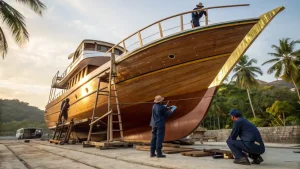
- Blocked areas. Where blocks and stands sit, the hull cannot be coated until they are moved. On a full job that block move is a scheduled event with its own hold point, not a last-day improvisation — see Bali slipway and hardstand.
Cure before launch
Most antifouls state both a minimum drying time before immersion and, for some products, a maximum time out of the water before the film loses effectiveness. Launching too early softens the coating and can wash biocide away; leaving certain ablatives ashore too long degrades them. Both figures come from the data sheet and both belong in the launch plan.
Between haul-outs
In Bali’s growth rates, scheduled diver scrubs between annual haul-outs are excellent value — they protect fuel consumption and cooling flow continuously. The scrub technique has to suit the coating, though: aggressive scrubbing of a soft ablative removes the coating along with the growth. That rhythm belongs in the calendar on yacht maintenance Bali, and the lift itself is planned as described on Bali haul out and dry dock.