Warm, highly conductive tropical water accelerates galvanic activity, so anodes in Bali are consumed faster and faults show up sooner than in temperate waters. An anode that disappears quickly is a symptom, not a consumable problem — the usual causes are a bonding fault, a dissimilar-metal problem, or stray current from shore power or a neighbouring vessel.
The three mechanisms, kept separate
They are routinely confused, and the fix for one does nothing for the others.
| Mechanism | Cause | Typical symptom |
|---|---|---|
| Galvanic corrosion | Dissimilar metals connected in an electrolyte. | Steady anode consumption; pitting on the less noble metal. |
| Stray-current corrosion | External current leaking through the vessel to water. | Very rapid, localised damage; anodes gone in weeks. |
| Crevice / poultice corrosion | Oxygen starvation under deposits, fittings or growth. | Hidden pitting under fittings, blocks and fouling. |
Anodes: chosen, sized and measured
Material
- Zinc — the traditional choice for salt water and still standard for most vessels in Bali.
- Aluminium — works in salt and brackish water, generally lasts longer, and suits vessels moving between salinities.
- Magnesium — fresh water only. In salt water it is consumed extremely fast and can over-protect, damaging paint on aluminium hulls.
Mixing anode materials on a single vessel undermines the protection scheme. Pick a system and stay with it.
Sizing and placement
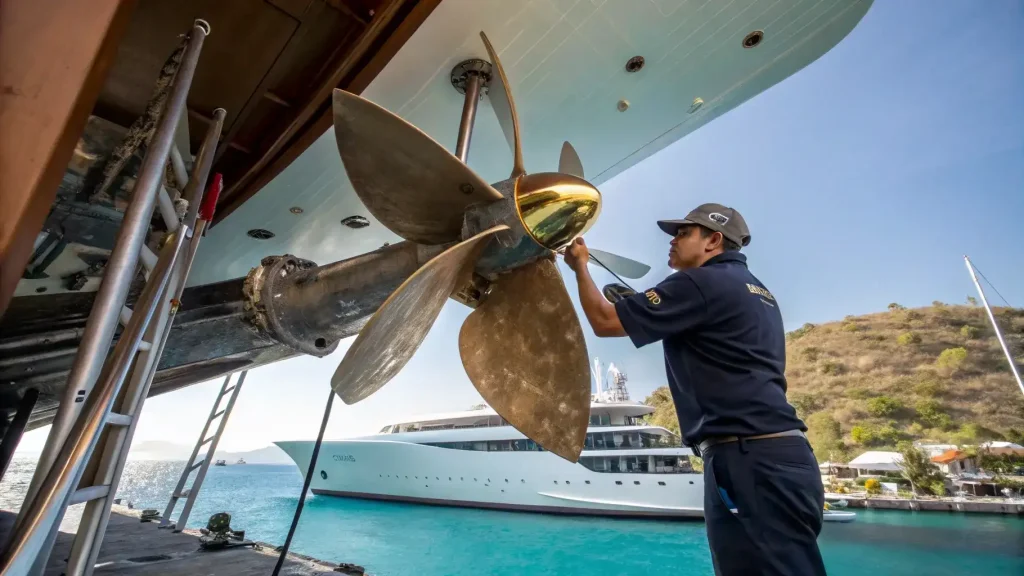
Anodes must be electrically connected to what they protect, adequately sized for the surface area involved, and distributed sensibly — shaft, propeller, rudder, trim tabs, and hull anodes where the bonding system requires. Anodes painted over, or bolted to a corroded surface with poor contact, protect nothing while appearing to be present.
Record the percentage consumed and the elapsed time at every inspection. Consumption rate is the diagnostic. Anodes half gone at six months on a boat that historically ran twelve is a fault that has already started.
Bonding continuity
The bonding system connects underwater metals so a single anode set can protect them all. It is also the most commonly broken system on a boat, because connections corrode in exactly the humid, salty environment they live in.
Testing is straightforward: with the vessel ashore and isolated, measure resistance between each underwater fitting and the bonding bus. Low resistance means connected; high or open means that fitting is unprotected regardless of how many anodes are fitted.
A broken bond typically shows up as an anode consuming abnormally fast while some other fitting quietly corrodes. That exact pattern is described in the first case in the project portfolio.
Stray current: the fast destroyer
Stray-current corrosion can destroy a propeller or a shaft in weeks. Sources, in rough order of frequency:
- Shore power faults — the most common. A wiring fault aboard, or on the dock, allows current to find a path through the water.
- Neighbouring vessels with their own faults, connected to the same shore supply.
- DC faults aboard — a chafed positive conductor touching a bonded metal component.
- Bilge pumps and submerged equipment with degraded insulation.
Practical protections: a galvanic isolator or isolation transformer on shore power; regular insulation-resistance testing of DC circuits; and simply disconnecting shore power when the vessel is unattended for long periods, which removes the largest single source.
Diagnosis
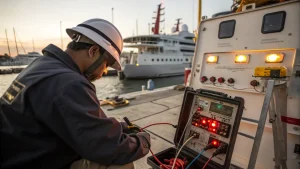
Hull-potential measurement with a reference electrode is the tool. Readings taken with shore power connected and disconnected, and with neighbouring vessels connected and disconnected, isolate the source quickly. It is a measurement job, not a guessing job — and it costs far less than replacing running gear.
Materials in a tropical marine environment
- Stainless steel depends on oxygen to maintain its passive layer. Immersed, in a crevice, or under a deposit it becomes vulnerable — which is why stainless fasteners fail where they are hidden, not where they are visible.
- Aluminium hulls and outdrives require copper-free antifoul and careful isolation from more noble metals, including yard blocking materials.
- Bronze fittings can dezincify, losing zinc and leaving a weakened pink copper structure that looks acceptable and is not. Old seacocks are the classic case.
- Steel hulls depend primarily on coating integrity; anodes are a backup for coating damage, not a substitute for coating.
Annual corrosion routine
- Photograph and measure every anode; record percentage consumed and elapsed months.
- Renew anodes; ensure clean metal-to-metal contact at the mounting.
- Test bonding continuity to every underwater fitting and record the readings.
- Inspect all bronze seacocks and through-hulls for dezincification; test rather than assume on anything over a decade old.
- Check shore-power isolation equipment is present and functioning.
- Insulation-test DC circuits, particularly bilge pumps and submerged equipment.
- Record hull potential as a baseline to compare against next year.
All of this belongs in the annual haul-out scope — see the 12-month maintenance calendar — and the readings belong in the job file described in documenting repairs for insurance and survey.
Reading the anodes as a diagnostic
| Observation | Likely meaning | Next step |
|---|---|---|
| Even consumption, roughly annual life | System working as designed | Record the rate; renew and continue. |
| Anodes barely consumed | Not electrically connected, or painted over | Test continuity to the fitting they protect. |
| One anode consumed far faster than others | Localised galvanic couple or a bonding break elsewhere | Continuity test across all underwater fittings. |
| All anodes gone within weeks | Stray current | Hull potential measurement with and without shore power. |
| Anodes intact but fittings corroding | Fittings not bonded into the system | Trace and repair the bonding conductor. |
| Paint blistering near anodes on an alloy hull | Over-protection | Review anode material and total mass. |
Habits that prevent most of it
- Disconnect shore power when the vessel is unattended for extended periods; it removes the largest single stray-current source.
- Never paint an anode or its mounting face; contact resistance defeats the whole system.
- Keep a single anode material across the vessel rather than mixing zinc and aluminium.
- Photograph anodes at each inspection alongside a scale, so consumption can be judged rather than recalled.
- Treat a fast-consuming anode as a fault report, not as a reason to fit a larger one.