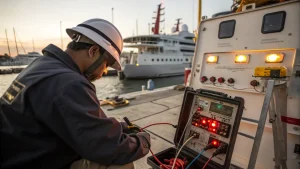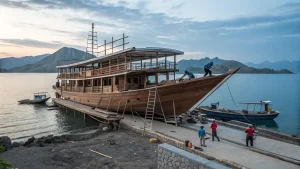

Charter-readiness is a second standard on top of mechanical condition: the boat must be safe, comfortable and self-sufficient in waters where help is far away. The pre-season inspection exists to catch, before the first booking, the failures that would otherwise happen in front of paying guests somewhere east of Lombok.
A boat working Bali to Komodo operates progressively further from support. In Bali a technician is an hour away. Around Komodo, a failed watermaker or air-conditioning compressor is a several-day problem. The inspection is calibrated to that reality.
1. Safety equipment and dates
- Liferaft — service in date, correctly stowed, hydrostatic release in date, painter secured to a strong point that is actually strong.
- Lifejackets — enough for maximum persons on board including crew, correct sizes for children if carried, inflation cylinders in date, lights working.
- EPIRB and PLBs — registration current, battery in date, tested per the manufacturer’s method.
- Flares — in date and accessible, not buried in a locker.
- Fire extinguishers and fixed systems — serviced, correct types for the risks, accessible from outside the engine space as well as inside.
- Medical kit — restocked, items in date, and appropriate to remote waters rather than to a day sail.
- Man-overboard equipment, and a recovery method actually practised by the crew rather than assumed.
Compile the expiry dates for every serviceable item onto one sheet with the next due date. It takes an hour once and prevents the discovery, mid-season and far from Bali, that the liferaft service lapsed in March.
2. Guest systems under tropical load
These are what guests actually notice, and they fail under load rather than at the dock.
- Air conditioning — run every unit for an extended period at full guest occupancy load, not a five-minute test. Check pump flow, strainer condition and condensate drainage, which blocks and floods soles.
- Refrigeration and freezers — verified to hold temperature in a hot engine space with the boat closed up, not measured on a cool morning.
- Watermaker — serviced, membranes checked, output and quality measured. In remote waters this is a primary system, not a convenience.
- Heads and holding tanks — every unit run, macerators serviced, tank levels and discharge arrangements checked, vents clear. Blocked heads are the most common guest complaint in this trade.
- Hot water and fresh-water pressure at simultaneous demand, which is when systems reveal themselves.
- Entertainment and connectivity, if it is being sold.
3. Machinery and redundancy
The question is not “does it work” but “what happens when it stops”.
- Main engines serviced with a full pre-season service, not a top-up.
- Generators — the item whose failure ends a charter fastest, since it takes air conditioning and refrigeration with it. Serviced, load-tested, and with a plan if there is only one.
- Bilge pumps, including manual backup, tested individually with the float switches.
- Steering and emergency steering, tested rather than assumed.
- Anchoring — windlass serviced, chain end-for-ended or replaced as needed, chain marked, and a second anchor genuinely deployable. Anchoring around Komodo can be deep and the current strong.
- Navigation and communication redundancy, including a means of communication that does not depend on cellular coverage.
4. Tender and water toys
The tender is a safety-critical item on a charter boat and it is routinely the least maintained thing aboard.
- Outboard serviced; spare propeller, shear pins and plugs carried.
- Tender fuel system and tank condition checked; hoses perish quickly in the sun.
- Davits, lifting points and falls inspected under load.
- Tender safety equipment aboard the tender itself — lifejackets, a means of calling for help, an anchor and a paddle.
- Diving and snorkelling equipment inspected and, where cylinders are carried, in current test.
5. Interior condition
Guests judge the boat before they judge the engineering. Mould in a cabin, a stained headlining, a jammed hatch or a sagging mattress cost repeat bookings.
- Deep clean including behind and under berths; treat any mould at source rather than covering it.
- Every hatch and window opened and closed; seals checked before the rain does it for you.
- Soft furnishings cleaned or replaced; humidity control in cabins and lockers.
- Lighting, blinds, catches and latches — small things that read as neglect collectively.
6. Spares for remote waters
| Category | Carry |
|---|---|
| Engine | Impellers, belts, filters (fuel, oil, air), oil, coolant, injector spares if applicable. |
| Electrical | Fuses, bulbs, terminals, a spare bilge pump, insulation tape and heatshrink. |
| Plumbing | Hose lengths, clamps, joker valves, pump service kits. |
| Damage control | Softwood plugs at every through-hull, epoxy putty, self-amalgamating tape, sealant. |
| Tender | Propeller, shear pins, plugs, repair kit, pump. |
| General | Fastenings, lashing line, spare anodes, cable ties, a decent tool kit. |
7. The written record
Finish the inspection with a signed sheet listing what was checked, what was found, what was rectified and what remains outstanding with a date. That sheet answers a charter broker’s questions, supports an insurance position, and gives the captain a defensible record of the vessel’s state at season start.
Anything the inspection turns up that is structural or has failed rather than degraded moves onto a repair scope — see Bali boat repair. If the list is long, the honest answer before a season is usually a yard period rather than a run of patches, which is yacht refit Bali. And the underlying rhythm that keeps this inspection short each year is the 12-month maintenance calendar.
Crew readiness, not just vessel readiness
A boat can pass every technical check and still fail a season on the human side. Three items belong in the same pre-season pass:
- Drills actually run. Man-overboard recovery, fire in the engine space, and abandon-ship, practised with the crew who will be aboard rather than described to them.
- Roles written down. Who does what in an emergency, posted where it can be read, so a new deckhand in week three is not improvising.
- Handover notes for the boat. Quirks, isolation points, where the spares live, which seacock feeds what. Crew turnover in this trade is normal, and knowledge that lives only in one head leaves with that head.
Record the drills with dates. It costs nothing, it improves the crew, and it is the first thing asked for after any incident.