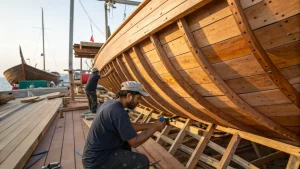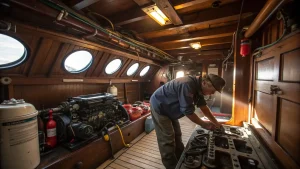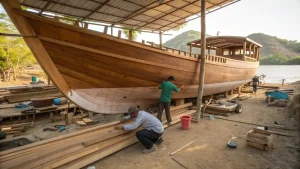
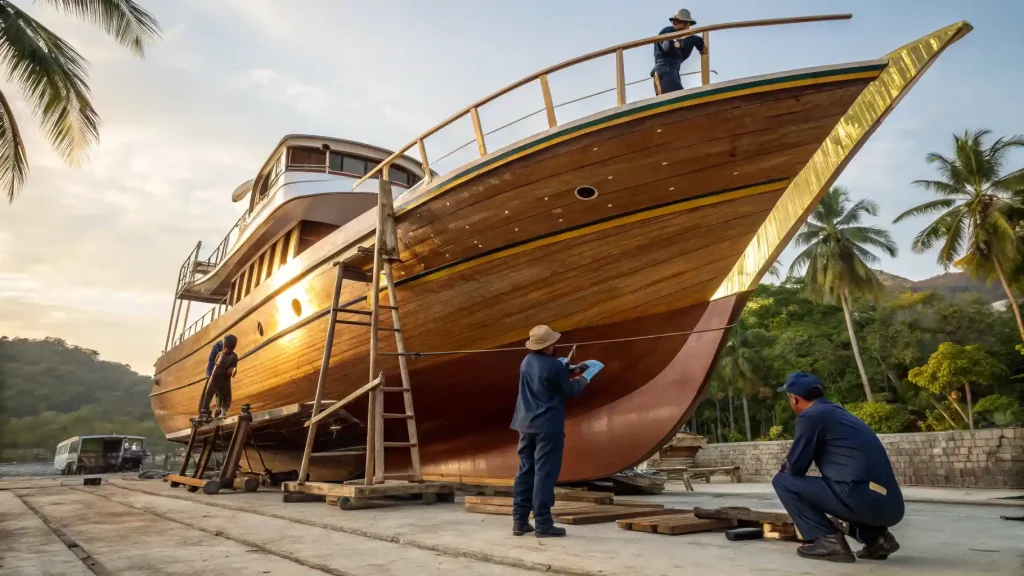
A boat repair in Bali runs through six stages: damage report, physical attendance, written scope with hold points, yard placement, supervised execution, and re-launch with sea trial. Jobs that skip the scope stage almost always cost more than jobs that do not, because everything discovered later becomes a negotiation instead of a variation.
Most owners meet the Bali repair market at the worst possible moment — after something has already broken. That is exactly when the temptation to move fast is strongest and when moving fast costs the most. This is the sequence that consistently works, and why each stage exists.
Stage 1: the damage report
The first message should answer five things: where the vessel is, what happened, whether it is taking water, what the crew has already done, and what the boat’s next commitment is. Photographs matter more than adjectives. A photograph of a crack with a tape measure next to it tells a surveyor more than three paragraphs of description.
If the vessel is unsafe, this stage is not about repair at all — it is about stabilising the boat. That process is separate and is covered in emergency haul-out after grounding or impact damage.
Stage 2: attendance
Somebody has to look at the boat. Remote diagnosis from photographs is fine for triage and useless for scoping, because the visible damage is almost never the full extent. On a GRP hull, an impact that leaves a 200mm scar on the outside can have delaminated an area several times larger behind it. On steel, a patch of surface rust can be a wastage problem that only ultrasonic thickness readings will reveal.
Attendance afloat covers everything above the waterline, the interior, machinery and systems. Anything below the waterline needs the boat lifted, which turns the timeline into a slot problem — see Bali haul out and dry dock.
What is measured at attendance
- Moisture readings across the affected area and a control area away from it, so the comparison means something.
- Ultrasonic thickness readings on metal hulls, recorded as a grid rather than a single spot.
- Photographic record before anything is disturbed. Insurance work depends on this absolutely.
- Systems run under load where relevant, because a component that works cold may not work hot.
Stage 3: the written scope
This is the stage that owners are most tempted to skip and the one that determines whether the job stays under control. A scope converts a work list into priced items with three things attached to each: what is included, what is explicitly excluded, and where the hold points are.
A moment where work stops and the item is inspected before proceeding — after stripping, after structural repair, before primer, before re-launch. Hold points force discovery to surface while it is still inexpensive to deal with, and they give the owner a defined moment to see the boat honestly rather than being told about it afterwards.
A good scope also carries a discovery allowance. Not a padding, an allowance: a stated sum for the work that experience says is likely once the surface is opened, with the mechanism to convert it into approved items or return it unused. A scope written with no allowance at all is either optimistic or dishonest, and both end in the same argument.
Stage 4: yard placement
The right yard for a job is decided by four filters in order: can it physically take the boat, does it have the specific capability, is there a real slot, and can it absorb a scope that grows. Proximity is a fifth consideration, not the first one. A yard 40 minutes further away with the right welder is faster than the near yard where your boat waits for one.
The geography and what each cluster suits is set out in Bali boat yard locations, and the underlying constraints in the shipyard capability guide.
Stage 5: supervised execution
Supervision is not standing over people. It is three specific functions:
Variation control. Anything not in the scope stops at a hold point, is photographed, is priced in USD, and proceeds only on written approval. This single discipline is what makes a final account recognisable.
Sequencing. Keeping trades from blocking one another — systems proven before joinery closes access, structural work complete before fairing starts, coatings scheduled against weather rather than against the calendar.
Recording. A photograph at each stage, coating figures where a system was applied, alignment and torque figures where they were set. This file is what an insurer or a buyer’s surveyor asks for years later, and it is nearly impossible to reconstruct after the fact. How to keep it usable is covered in documenting repairs for insurance and survey.
Stage 6: re-launch and sea trial
Re-launch is a hold point in its own right. Before the slings are released in the water: every seacock checked and exercised, stern gland set and observed, bilges dry, shaft alignment confirmed if the boat has moved on blocks, and somebody aboard watching. The boat then stays alongside under observation before it goes anywhere.
Sea trial follows for anything involving propulsion, steering or structural repair. It is run against the scope, not as a formality: temperatures and pressures recorded, vibration checked across the rev range, steering tested lock to lock, and any snag written down rather than remembered. Snags are closed before handover, not afterwards.
How long each stage takes
| Stage | Typical duration | What delays it |
|---|---|---|
| Damage report to attendance | 1–2 days | Vessel location and access. |
| Attendance to written scope | 2–4 days | Whether a lift is needed to complete the assessment. |
| Scope to lift | Days to weeks | Slot availability; worst before the dry season. |
| Execution | Per scope | Discovery, coating windows, parts lead time. |
| Re-launch to handover | 1–2 days | Snag closure and sea-trial weather. |
The three mistakes that cost the most
Verbal scopes. “You know what needs doing” is the beginning of every disputed account in this trade.
Repairing the symptom. Refinishing an interior before the deck leak above it is proven dry means paying twice. Proving it dry costs a rain event and a bucket of patience.
Booking the yard before ordering the parts. Imported components carry freight and clearance time. A boat sitting on blocks waiting for a part is paying hardstand fees to do nothing, and that mistake is the single most common cause of a repair that “took three months” when the work was three weeks.
If the accumulated work list is long enough that these stages repeat several times, the honest recommendation is usually a single programme instead — see yacht refit Bali.