
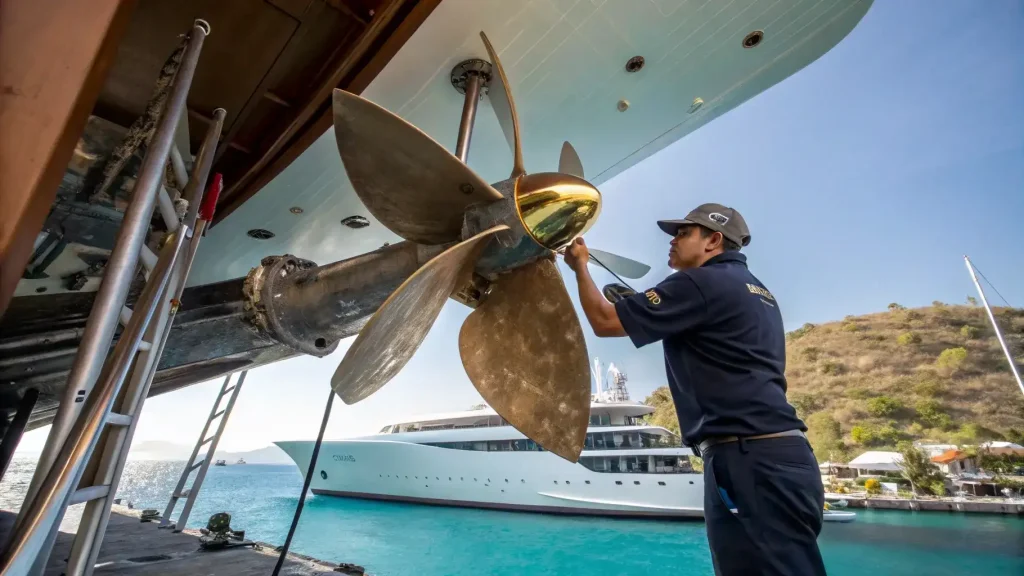
Running gear is the highest-value inspection of any haul-out, because it is the only time you can measure it properly. The core checks are cutless bearing clearance, shaft seal condition, shaft straightness and wear, propeller condition and pitch, and rudder bearing clearance. All of them are quick to check and expensive to ignore.
In Bali’s warm water, running gear works harder than most owners assume. Fouling loads the propeller, growth in the shaft log accelerates bearing wear, and electrolysis is more aggressive than in cooler water. Annually, with the boat out, is the moment to get honest numbers.
Cutless bearings
The cutless bearing supports the shaft in the P-bracket or stern tube. It wears, and when it does the shaft moves — which then destroys the seal, unbalances the propeller and vibrates the whole drivetrain.
Check: grip the shaft near the bearing and try to move it vertically and laterally. Any perceptible play at that point is more than it appears at the propeller. Also look for uneven wear patterns, which indicate misalignment rather than simple age.
Note: a cutless bearing that has worn unevenly is a symptom. Replacing it without addressing the alignment behind it means replacing it again next year — see the alignment discussion in repowering in Bali.
Shaft seals
| Seal type | Check | Common failure |
|---|---|---|
| Traditional stuffing box | Packing condition; gland adjustment; hose and clamps. | Over-tightening scoring the shaft; perished hose. |
| Dripless face seal | Bellows condition and age; carbon face wear; vent line clear. | Age-expired bellows — a genuine sinking risk. |
| Lip seal | Lip condition; shaft surface at the seal. | Grooved shaft at the running surface. |
Dripless seal bellows age on a calendar, not on hours. A bellows failure at sea floods the boat through a hole the size of the shaft. If nobody can say when it was last replaced, that is the answer: replace it.
Shafts
- Straightness. Checked on rollers or in place with a dial indicator. A bent shaft causes vibration that gets blamed on the propeller and destroys bearings and seals.
- Surface condition at the bearing and seal running surfaces. Grooving means the seal will not seal regardless of how new the seal is.
- Corrosion and pitting, particularly near the coupling and where the shaft sits in the log.
- Keyway condition and coupling fit.
- Withdrawal. Periodically the shaft should come out entirely for inspection along its full length. It is the only way to see what is hidden inside the log.
Propellers
Propellers get treated as durable, and they are not. Small damage has a disproportionate effect on efficiency and vibration.
- Edge damage and dings — even minor deformation of the leading or trailing edge costs efficiency and generates cavitation.
- Erosion and cavitation burn on blade faces, usually a symptom of a pitch, alignment or flow problem rather than a propeller problem.
- Balance and pitch accuracy. A propeller can be checked and reconditioned to specification; on a boat that vibrates, this is often the answer.
- Pitch against performance. If the engine cannot reach its rated wide-open-throttle rpm, the boat is over-propped and the engine is being overworked continuously. Re-pitching fixes it.
- Rope cutters, which in Indonesian waters with widespread fishing gear and floating lines earn their cost quickly.
Rudders
Rudders are inspected less than they should be and fail expensively.
- Bearing clearance — measured at the blade, where a small clearance at the bearing shows up as significant movement.
- Stock condition where it enters the blade. Corrosion here is hidden and is the classic cause of a rudder failing at sea.
- Water inside the blade. A hollow rudder that has taken water is heavier, can freeze internally in cold climates and, more relevantly here, corrodes the internal structure. Drill-and-drain testing at haul-out answers it.
- Steering linkage, quadrant, tiller arm and stops, including the emergency steering provision, which nobody tests until they need it.
Anodes and bonding
Running gear is where galvanic protection is proved or disproved. Anodes are measured, not glanced at, and the rate of consumption is as informative as the amount remaining. An anode that disappears in months indicates a fault — commonly a bonding problem or stray current — rather than a need for a bigger anode. This is covered fully in tropical corrosion control.
Record the measurements
Every one of these checks produces a number: bearing clearance, shaft runout, blade thickness, anode consumption. Recorded consistently, they turn into a trend, and a trend tells you when something is going to fail before it does. Recorded nowhere, each haul-out starts from zero and everything looks acceptable.
How to keep that record usable is covered in documenting repairs for insurance and survey, and the scheduling that makes it happen is on yacht maintenance Bali. To plan the lift where the work happens, see Bali haul out and dry dock.
Diagnosing vibration before you replace anything
Vibration is the symptom most often treated by replacing the propeller, and the propeller is often innocent. Work through the causes in order rather than in order of cost:
| Symptom | Likely cause | Check |
|---|---|---|
| Vibration at all speeds, worse with load | Shaft misalignment | Alignment measured afloat after settling. |
| Vibration appearing at one rev band | Propeller balance or blade damage | Blade inspection; balance and pitch check. |
| Rumble with play at the shaft | Cutless bearing wear | Physical play test at the bearing. |
| Vibration after a grounding or line strike | Bent shaft or distorted blade | Shaft runout on rollers; blade geometry. |
| Steering-related vibration | Rudder bearing clearance | Play measured at the blade, not at the stock. |
| New vibration after a repower | Alignment set on blocks, never re-checked | Re-align afloat and after running-in hours. |
Building a running-gear baseline
The first haul-out where all of this is measured is the expensive one, because everything is unknown and everything looks acceptable. From the second onwards, you are comparing against a baseline, and comparison is what turns an inspection into a prediction. Record clearances, runout, blade condition and anode consumption in the same format each year, and the boat starts telling you when a component is entering its last season rather than surprising you in the middle of one.